
Chapter 2 · Owning · by HBi Auto
Owning a Porsche: maintenance, fluids and repairs
The maintenance schedule for every generation, what is due on your car, and the repairs to plan for.
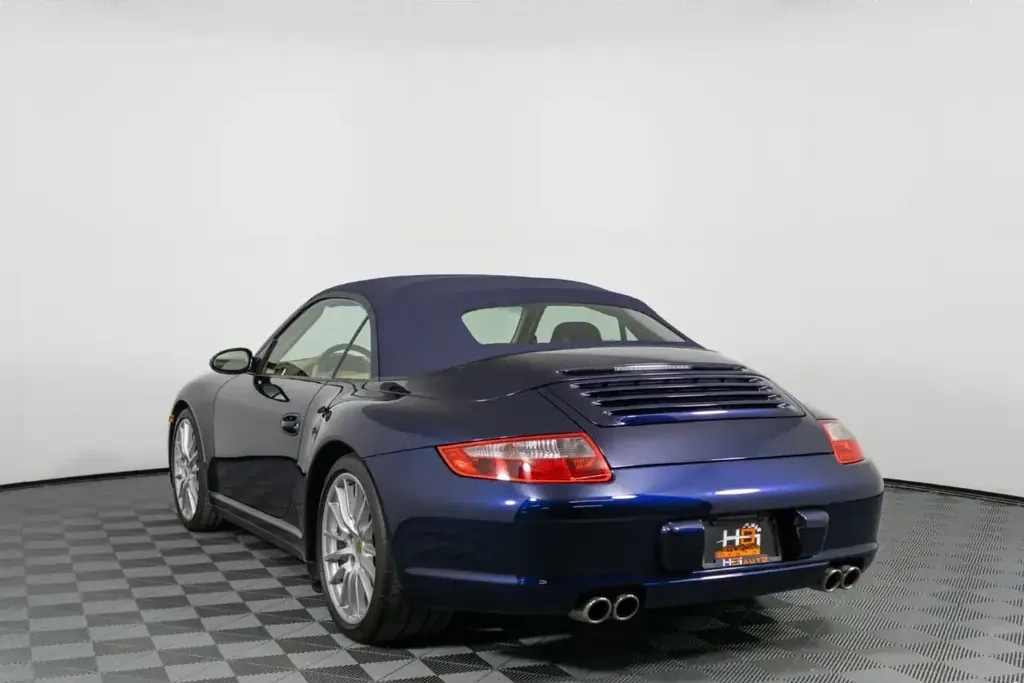
A Porsche maintained on time, with the right fluids, will run for hundreds of thousands of miles and hold its value. Most expensive failures we see started as something small that was skipped. This chapter covers what to do when you get the car, the maintenance schedule for every generation, and the repairs to plan for.
The first 30 days
Baseline service
Unless the records prove it was just done: oil and filter, brake fluid and a full inspection, so the clock starts on your watch.
Read the engine computer
A factory PIWIS scan shows stored faults and, on manual cars, the over-rev history. Keep a copy with your records.
Tires by date, not tread
Porsche tires harden with age. Check the four-digit date code; old tires on a fast car are the cheapest thing to fix.
Battery and charger
Modern Porsches drain batteries when parked. A maintainer on any car that sits more than a week saves electrical headaches.
Start the file
Every invoice, the window sticker and the build sheet in one folder. A complete file is worth real money when you sell.
Maintenance planner: every generation
Porsche services by miles or years, whichever comes first: an oil service every year or 10,000 miles on most cars since 2009, an inspection every 20,000 miles or two years, and bigger items (plugs, filters, belt, gearbox oils) at 30,000 to 120,000 miles. Choose your car below.
Maintenance planner
Pick the car, enter its miles and model year: the planner shows what is due now, the next services and the full schedule, whichever comes first, miles or years.
| What is done | 10k | 20k | 30k | 40k | 50k | 60k | 70k | 80k | 90k | 100k | 110k | 120k |
|---|---|---|---|---|---|---|---|---|---|---|---|---|
| Engine oil and filterEvery 10,000 mi, 1 yr · Porsche US | ● | ● | ● | ● | ● | ● | ● | ● | ● | ● | ● | ● |
| Inspection: lights, brakes, tires, leaks, fault memory, test driveEvery 20,000 mi, 2 yr · Porsche US | ● | ● | ● | ● | ● | ● | ||||||
| Cabin (pollen) filterEvery 20,000 mi, 2 yr · Porsche US · Changed at the 20,000-mile inspection | ● | ● | ● | ● | ● | ● | ||||||
| Brake fluidEvery 2 yr · Porsche US | ||||||||||||
| Spark plugsEvery 40,000 mi, 4 yr · Porsche US | ● | ● | ● | |||||||||
| Engine air filtersEvery 40,000 mi, 4 yr · Porsche US | ● | ● | ● | |||||||||
| Drive beltEvery 60,000 mi, 6 yr · Porsche US | ● | ● | ||||||||||
| PDK clutch fluidEvery 60,000 mi, 6 yr · Porsche US | ● | ● | ||||||||||
| AWD controller oil (all-wheel drive)Every 60,000 mi, 6 yr · Porsche US · Carrera 4 and 4S | ● | ● | ||||||||||
| Front differential oil (all-wheel drive)Every 120,000 mi, 12 yr · Porsche US · Carrera 4 and 4S | ● | |||||||||||
| Manual gearbox oilEvery 120,000 mi, 12 yr · Porsche US | ● | |||||||||||
| PDK / automatic transmission oilEvery 120,000 mi, 12 yr · Porsche US | ● | |||||||||||
| Tire sealant (if fitted)Every 4 yr · Porsche US |
Why fluids matter
| Fluid | What it protects | What happens when it is skipped |
|---|---|---|
| Engine oil | Bearings, cams, timing chains | Sludge and wear; on high-revving engines it shortens engine life directly. |
| Brake fluid | Braking under heat | It absorbs water over time; the pedal goes soft when the brakes get hot. Porsche changes it every two years. |
| Coolant | Engine temperature, water pump, radiators | Old or wrong coolant corrodes the system from the inside and leads to leaks and overheating. |
| Gearbox and PDK fluid | Gears, synchros, PDK clutches | Harsh shifts and wear on parts that cost far more than the fluid. |
| Differential and transfer case | All-wheel-drive and limited-slip parts | Noise and wear that ends in a rebuild. |
Preventive maintenance: fix it before it breaks
The cheapest repair is the one done before a part fails and takes others with it. A water pump replaced on schedule is a few hundred dollars; one that fails can overheat the engine. The same is true of coolant pipes, engine mounts, suspension bushings and brake hoses. A specialist who knows the model will tell you what to replace before it becomes a problem.
HBi Auto service plans
Preserve
For the car you drive: the factory schedule plus yearly care for the fuel system, battery and electronics, tires and alignment.
Heritage
For the car you are keeping: everything that makes it start, stop, steer and stay dry brought back to a known-good baseline, then kept there.
Common repairs by generation
911 Early 911 & 930 Turbo (1964–1989)
Rust
Floors, front pan, kidney bowls and door bottoms. Repair costs dwarf mechanical work.
Chain tensioners
Early tensioners fail; most cars have been upgraded to the pressure-fed Carrera type. Ask for proof.
Head studs
2.7-litre engines from 1974–77 are known for pulled head studs.
Matching numbers
Engine and gearbox numbers that match the car add real money. Verify them on the inspection.
911 964 (1989–1994)
Oil leaks
Cylinder-base and chain-cover leaks are common; budget for them if the car has not been resealed.
Dual-mass flywheel
Rattles at idle mean it is worn. Many have been replaced with a single-mass conversion.
Ignition
The twin-plug ignition has a distributor belt that should be renewed on a schedule.
911 993 (1994–1998)
Secondary air injection
Clogged ports set a check-engine light and can be expensive to clear. Ask whether it has been done.
Valve guides
Higher-mile engines can wear valve guides; a leak-down test and oil-use history tell you.
Oil leaks
Common and usually manageable; price them in.
911 996 (1999–2005)
IMS bearing (Carrera)
The intermediate-shaft bearing on M96 engines can fail without warning. Many have been upgraded; ask for the invoice. Mezger cars do not have this problem.
Rear main seal
An oil leak between engine and gearbox. Common; often done together with the IMS and clutch.
Bore scoring
Scored cylinder walls on higher-mile engines. A borescope inspection settles it.
Coolant system
Radiators behind the front bumper collect debris and corrode; check them and the expansion tank.
911 997 (2005–2012)
IMS bearing (997.1)
Still present on the M97, but the larger bearing fails far less often than on the 996. It cannot be replaced without opening the engine.
Bore scoring (997.1)
More common on the 3.8 S. A borescope is the only way to know before you buy.
Coolant pipes and radiators
Same front radiators as the 996; check for debris and leaks.
PDK (997.2)
Reliable; check the software and that the fluid was done on schedule.
911 991 (2012–2019)
991.1 GT3 engines
Early cars were recalled and many had engines replaced by Porsche. Check what was done and that the paperwork is with the car.
Over-revs
Manual cars store over-rev history in the engine computer. Read it with a factory scan.
Front lift and PDCC
Check every hydraulic option works; they are costly to fix.
911 992 (2019 on)
Warranty and CPO
Many cars are still under Porsche warranty or eligible for Porsche Approved; check the dates.
Options
Option prices are huge on 992s; decode the VIN so you only pay for what is fitted.
Paint protection and wheels
Check film, stone chips and curbed wheels; they are what moves the price on low-mile cars.
Boxster 986 Boxster (1997–2004)
IMS bearing
Same family of engine as the 996; ask whether the bearing has been upgraded.
Rear main seal
Common oil leak; often done with the clutch.
Top
Check the hood and its mechanism; repairs add up.
Boxster 987 Boxster (2005–2012)
IMS bearing (987.1)
As on the 997.1; the 987.2 does not have it.
Bore scoring
Check with a borescope on 987.1 cars.
Coolant system
Radiators and the expansion tank.
Boxster 981 Boxster (2013–2016)
Track use
GT4s are often tracked; check brakes, tires, alignment and the over-rev history.
Coolant
Check the radiators and front of the car for debris.
Boxster 718 Boxster (2017 on)
Flat-four vs flat-six
Decide first; it changes the price and the resale more than miles.
Track use
GT4 and Spyder: brakes, tires, alignment and over-rev history.
959, Carrera GT & 918 (1987–2015)
Records
Every service, every owner, every repair. Gaps cost more on these cars than on any other Porsche.
Tires and fluids by age
Low-mile cars still need time-based service.
Cayenne 955 / 957 (2003–2010)
Coolant pipes
Plastic coolant pipes in the V8's engine valley are a known failure; ask whether they were replaced with metal ones.
Driveshaft and transfer case
Listen for clunks and check for vibration.
Air suspension
Check it holds height overnight.
Cayenne 958 (2011–2018)
Air suspension
Check every height setting.
Hybrid battery
On hybrids, check battery health with a factory scan.
Cayenne 9Y0 (2019 on)
Warranty
Check the remaining Porsche warranty and Porsche Approved eligibility.
Panamera 970 (2010–2016)
Air suspension and PDCC
Check every mode works.
Electronics
Run a factory scan; these cars have many control units.
Panamera 971 (2017–2023)
Warranty
Later cars may still be covered.
Macan 95B (2015–2024)
PDK service
The transmission fluid is on a schedule; check that it was done.
Brakes and tires
Heavy and fast: they wear quickly.
Macan Electric Macan (2024 on)
Battery warranty
Check the remaining battery warranty.
Taycan Taycan (2020 on)
Battery health
Ask for a battery health report from a factory scan.
Charging equipment
Check the charging cable and any home charger are included.
Recalls
Check open recalls with Porsche.
Written by the 911 Buyers and HBi Auto team in Mocksville, NC. Market numbers come from 911 Tracker's VIN-checked US sales and say what they are based on; maintenance intervals say where each one comes from. This course is general information, not an inspection, an appraisal or legal or tax advice.